The Swarm Over Moscow: How Ukraine’s Drone Campaign Is Burning Russia’s Retail Giant
Investigation

Image: NOELREPORTS (@noelreports.com) via Bluesky
Overnight on August 15–16, 2026, the night sky over the Moscow region filled with the low, persistent hum of hundreds of low-altitude engines, signaling one of the most massive coordinated aerial assaults on the Russian capital since the war began. By dawn, a towering pillar of thick black smoke rose from Koledino, near Podolsk, where Russia’s largest e-commerce logistics hub—a massive 250,000-square-meter warehouse belonging to the retail giant Wildberries—was engulfed in a catastrophic fire, as reported by The Kyiv Independent.
The strike was so expansive that it forced the Russian Federal Air Transport Agency, Rosaviatsiya, to abruptly suspend flight operations at three of Moscow’s four major airports: Vnukovo, Domodedovo, and Zhukovsky, according to The Guardian. But while the immediate visual of a burning warehouse and grounded commercial flights captured global headlines, the true target of the Ukrainian drone swarm was not merely physical infrastructure. It was the delicate, highly leveraged financial scaffolding of the Russian domestic economy, a strategic focus highlighted by analysts at Riddle.
Wildberries in Moscow region 🔥
— MAKS 26 👀🇺🇦 (@maks23.bsky.social) View on Bluesky
For months, Ukraine has been quietly scaling up its domestic drone production, moving away from sporadic nuisance strikes to highly coordinated, saturation-style swarm tactics. According to Moscow Mayor Sergei Sobyanin and regional Governor Andrey Vorobyov, the overnight assault involved an unprecedented number of aircraft, with Russian officials claiming that up to 600 drones targeted the Moscow region alone, as detailed by The Guardian.
Military analysts note that the operation relied heavily on a combination of Ukrainian-designed "FP-1" long-range strike drones, developed by the defense firm Fire Point, and "Sych" strike-reconnaissance drones, as documented by UATV and Militarnyi. The FP-1 drones, designed specifically for deep-penetration missions into Russian territory, are engineered to bypass electronic warfare umbrellas by utilizing low-altitude flight paths and advanced autonomous guidance, a capability highlighted by dev.ua.
By saturating Russian air defenses with hundreds of decoys and strike platforms simultaneously, Ukrainian forces successfully penetrated the heavily defended airspace of the Moscow Oblast. Multiple drones struck the Koledino facility, triggering an intense blaze that quickly spread across the sprawling complex, as confirmed by geolocated video footage verified by CNN.
To understand why Ukraine is dedicating hundreds of advanced drones to strike retail warehouses rather than purely military bases, one must look at the structural vulnerabilities of the Russian economy. Wildberries is not just an online store; it is Russia’s largest marketplace, a vital economic engine that has kept consumer goods flowing despite heavy Western sanctions, as detailed by Frontelligence Insight.
The Koledino logistics hub was the crown jewel of this network. Spanning a quarter of a million square meters, the facility acted as the primary distribution artery for the Moscow region. The strike on Koledino is part of a systematic, highly calculated campaign by Ukrainian intelligence; according to the Ukrainian Defense Ministry, this latest attack means Ukraine has now successfully disabled 7 of Wildberries’ 10 largest logistics centers across Russia, a devastating blow reported by the Kyiv Post.
The physical destruction of these hubs triggers a massive cascade of financial liabilities. Each of these mega-warehouses holds between $1 billion and $1.5 billion in consumer inventory, as analyzed by Riddle. When a hub burns, the financial losses extend far beyond the destroyed concrete and steel.
The ultimate objective of this campaign is to trigger a systemic shock within the Russian banking sector. Wildberries’ rapid expansion has been fueled by immense debt, much of it held by state-owned financial institutions. In particular, Russia’s second-largest state-owned bank, VTB Bank, is heavily exposed to Wildberries’ debt, which is estimated to be in the hundreds of billions of rubles, according to Frontelligence Insight.
Furthermore, Wildberries operates its own financial subsidiary, Wildberries Bank (WB Bank), which is deeply integrated with VTB's clearing systems. As Ukrainian drone strikes systematically dismantle Wildberries’ physical capacity to fulfill orders and generate revenue, the company faces a severe liquidity crisis. This directly threatens the stability of VTB Bank’s balance sheet, as detailed by Militarnyi.
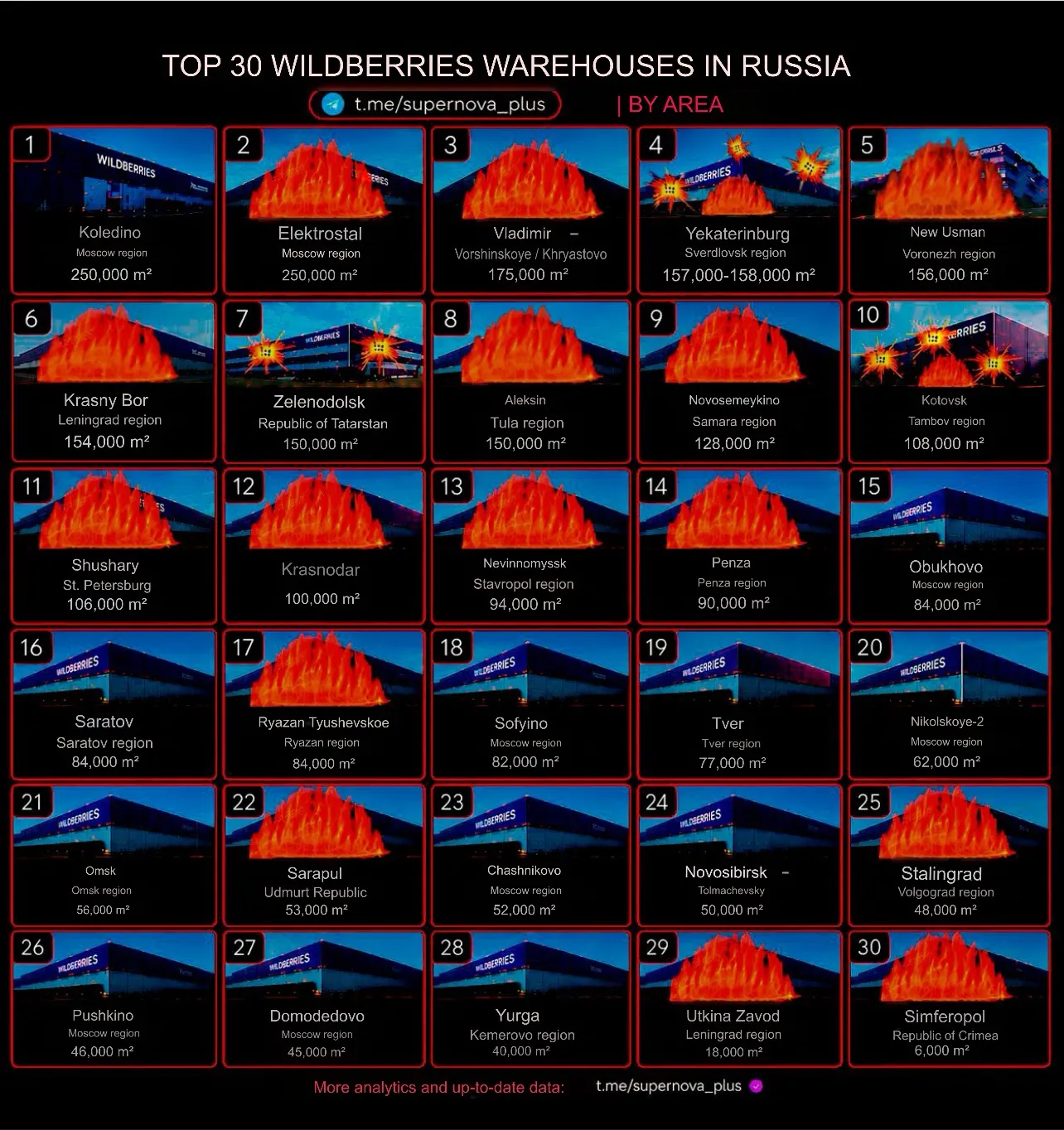
The Russian Central Bank has already begun urging major lenders to explore debt restructuring and emergency support mechanisms for businesses heavily impacted by the warehouse strikes, a sign of growing panic reported by The Moscow Times. Total estimated damages to Wildberries' logistics infrastructure from the ongoing Ukrainian campaign now range from $1.3 billion to over $2.2 billion, creating a massive capital black hole that the Russian state may ultimately have to fill, according to UNN.
In evaluating the fallout of the August 16 strike, a key distinction must be made between the immediate operational "disabling" of the facility and its total physical "destruction." While sensationalized social media reports claimed the warehouse was entirely leveled, official emergency reports and local statements indicate that the facility was rendered completely inoperable due to severe structural fire damage, as noted by The Guardian. Whether the concrete shell remains standing is secondary to the immediate operational reality: the hub is offline, its inventory is incinerated, and its supply chains are severed.
Furthermore, while the Russian Ministry of Defense claimed to have intercepted the vast majority of the incoming drones, the sheer scale of the fire at Koledino—and the subsequent grounding of flights at three major airports—strongly contradicts the narrative of a highly successful interception campaign, as discussed by MigFlug.
The weight of evidence firmly supports the conclusion that Ukraine's drone campaign has successfully compromised Russia's largest retail logistics node, dealing a severe blow to both Wildberries and its financial backers. While Russian state media and defense officials emphasize high interception rates, the undeniable physical reality of the Koledino fire and the resulting aviation shutdowns, documented by Euromaidan Press, demonstrates that the defensive shield failed to protect a critical economic asset.
Two critical questions remain unanswered. First, the exact percentage of the physical structure at Koledino that was permanently ruined versus the portion that could eventually be salvaged remains unclear without high-resolution post-strike satellite imagery. Second, the precise extent of the financial write-offs that VTB Bank and Wildberries will have to absorb has not yet been publicly disclosed in corporate filings, though the Russian government is actively exploring ways to support the company, as reported by The Star Online.
Ultimately, this assessment would only shift if Wildberries were able to rapidly restore operations at Koledino or if independent financial audits proved that the company's debt exposure to VTB Bank was insulated from these physical losses. For now, the smoke rising over the Moscow region is a vivid demonstration of a new front in the war—one where silicon, software, and logistics are proving just as volatile as artillery on the front lines, a reality underscored by Ukraine's evolving strategy to target the financial pillars of the Russian state, as detailed by Militarnyi.